
“Be transformed by the renewal of your mind, that by testing you may discern what is the will of God, what is good and acceptable and perfect.” — Romans 12:2 (ESV)
Trauma and chronic stress are not just emotional experiences—they are biological forces that leave lasting marks on the developing brain. For at-risk youth, these forces often begin early in life, quietly shaping how they think, react, and relate to the world around them. What many label as defiance, poor judgment, or a lack of discipline is often something far deeper: a brain trained for survival rather than stability. Let’s call it straight, kids don’t wake up one morning and decide to struggle with authority, distrust others, or quit when things get hard. Those patterns are learned, reinforced, and, in many cases, wired into their neurological framework through repeated exposure to adversity.
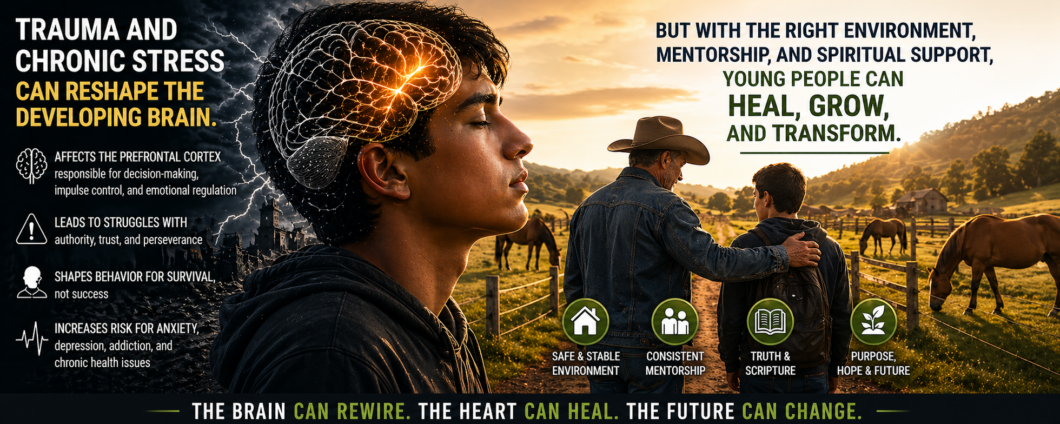
Medical research over the past two decades has made this clear. Adverse Childhood Experiences (ACEs)—including abuse, neglect, and household dysfunction have been shown to significantly alter brain development. Studies in journals such as Nature Neuroscience and CDC-supported research demonstrate that chronic stress affects key brain regions, particularly the prefrontal cortex, amygdala, and hippocampus. The prefrontal cortex, responsible for decision-making, impulse control, and emotional regulation, often shows reduced activity or delayed development under prolonged stress, while the amygdala, the brain’s alarm system, becomes hyperactive, constantly scanning for danger. Add elevated levels of cortisol, the body’s primary stress hormone, and you have a system running in overdrive. Over time, this toxic stress impairs memory, learning, and emotional balance, increasing the risk of anxiety, depression, addiction, and chronic disease later in life. What many interpret as character flaws are, in truth, survival adaptations.
Now here’s the turn—and it’s a powerful one. The brain is not fixed. It is adaptable. Neuroscience calls this neuroplasticity—the brain’s ability to reorganize itself by forming new neural connections. In plain terms, no matter how a brain started, it can be reshaped through new experiences, consistent relationships, and intentional guidance. Long before modern science named it, Scripture pointed directly to it. Romans 12:2 calls for transformation through the renewal of the mind, which aligns precisely with what neuroscience now confirms: repeated positive input, disciplined thinking, and healthy behavior can literally rewire the brain. But this transformation doesn’t happen in isolation. It requires a steady environment, strong mentorship, and truth that is lived out consistently. A structured, predictable setting gives the brain something it may have never had—safety. When safety becomes consistent, the brain begins to settle, and higher-level thinking can take root. Add to that a committed mentor—someone who shows up, speaks truth, and doesn’t disappear when things get hard—and the impact multiplies. Research consistently shows that even one stable, supportive relationship can significantly reduce the long-term effects of trauma.
This is where spiritual truth deepens the work. “For God gave us a spirit not of fear but of power and love and self-control.” — 2 Timothy 1:7 (ESV) speaks directly to what trauma distorts. Fear becomes dominant, but Scripture reminds us it was never meant to define us. Power, love, and self-control—those are learned, strengthened, and restored over time. Faith introduces something science alone cannot supply: purpose. When a young person begins to understand they are created in the image of God, that their life has meaning, and that their past does not determine their future, a shift begins. Psychological and medical research supports this reality as well—individuals with a strong sense of purpose and belonging show greater resilience, improved emotional regulation, and better long-term health outcomes. Faith-based environments often lower stress responses and improve coping skills, reinforcing what Scripture has long declared. “He heals the brokenhearted and binds up their wounds.” — Psalm 147:3 (ESV) is not just poetic language; it reflects a process of restoration that is both spiritual and biological.
Now, let’s be honest—this kind of transformation takes time. You don’t undo years of stress conditioning overnight. There will be setbacks, moments of regression, and days when progress feels slow. But slow progress is still progress. Every positive interaction, every moment where discipline is paired with grace, every truth reinforced—these begin to build new pathways in the brain. Over time, those pathways strengthen, allowing for better decision-making, emotional stability, and trust. Programs that integrate structure, mentorship, and faith-based principles are uniquely equipped to foster this kind of change. Whether through hands-on work, equine therapy, vocational training, or consistent daily routines, these environments create repetition—and repetition is how the brain learns. It’s also how the heart changes. “And we know that for those who love God all things work together for good, for those who are called according to his purpose.” — Romans 8:28 (ESV) reminds us that even the hardest chapters of life can be redeemed and repurposed.
So when you encounter a young person who seems difficult, distant, or defiant, don’t stop at what you see. Look deeper. You’re witnessing the outward expression of an inward struggle—a brain shaped by hardship, doing exactly what it was trained to do: survive. But survival is not the final destination. With the right environment, the right relationships, and the truth of Scripture consistently applied, that same young person can grow into someone marked by resilience, purpose, and gratitude. That’s not wishful thinking—it’s the convergence of solid science and the unchanging truth of God’s Word, both pointing to the same conclusion: transformation is not only possible, but it is also within reach.
